x402 vs Stripe vs Lightning
Which Fits Your AI Agent?
Not all payment systems are built for autonomous AI agents. This guide compares the leading options on the dimensions that matter: minimum payment, autonomy, latency, and setup effort.
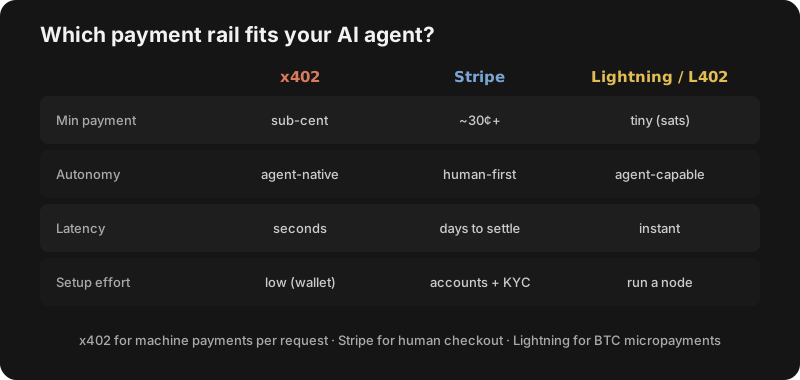
Full Comparison Table
| Protocol | Min Payment | Agent-Native | Latency | Setup | Open Source |
|---|---|---|---|---|---|
| x402 + USDC (Base) ⭐ Recommended | $0.0001 | ✅ Yes | ~2s | Easy | ✅ Yes |
| Stripe | $0.30 | ❌ No | ~3 days | Medium | ❌ No |
| Lightning Network | ~$0.00001 | ⚠️ Partial | <1s | Hard | ✅ Yes |
| OpenMeter | Custom | ⚠️ Partial | N/A | Medium | ✅ Yes |
| Solana Pay | $0.001 | ⚠️ Partial | <1s | Medium | ✅ Yes |
| Traditional API Keys | N/A | ❌ No | Instant | Easy | N/A |
How each option actually compares
A table can't capture the trade-offs. Here's the honest read on where each rail wins and where it doesn't.
x402 + USDC on Base
The only option on this list designed from the ground up for software paying software. A server answers a request with HTTP 402 and JSON payment requirements; the client pays USDC on Base and retries with proof. No accounts, no card, no human. Sub-cent pricing is economical because Base fees are well under a cent and there is no fixed per-transaction floor. Best for AI agents, pay-per-request APIs and machine-to-machine billing.
Stripe
The gold standard for human checkout, invoices and subscriptions, with unmatched fraud tooling and a polished dashboard. But it assumes a cardholder and an account, settles over bank rails in days, and the effective per-transaction cost (~$0.30 + percentage) makes true micropayments uneconomic. Great for billing human developers; wrong tool for autonomous agents.
Lightning Network
Bitcoin Layer 2 capable of instant, extremely small payments. Technically excellent for high-frequency micro-transfers, but channel management, liquidity and node operations make it harder to integrate, and agent support is still maturing. Settles in BTC, so you take on volatility unless you convert.
Solana Pay / others
Fast, cheap on-chain payments on Solana with sub-second finality. A solid rail, but oriented toward wallet-to-merchant flows rather than the inline request-and-retry handshake that makes x402 drop into existing HTTP servers.
Traditional API keys
Not a payment system at all — a pre-arranged credential plus an out-of-band invoice. Simple, but it requires onboarding, key distribution and manual billing, none of which an autonomous agent can do on its own.
Decision Guide
Why x402 Wins for AI Agents
Frequently asked questions
What is the best payment protocol for AI agents?
For autonomous AI agents paying APIs, x402 with USDC on Base is purpose-built: it needs no account or card, settles on-chain in about two seconds, and supports sub-cent amounts. Stripe remains best for human checkout and subscriptions, and Lightning suits ultra-high-frequency Bitcoin micropayments.
Is x402 cheaper than Stripe?
For small payments, yes. Stripe has an effective floor around $0.30 per transaction, so a $0.01 charge is impossible to run profitably. x402 on Base has no fixed floor and network fees under a cent, making per-request and per-token pricing viable.
Can I use x402 and Stripe together?
Yes. Many products bill humans with Stripe for subscriptions and expose an x402 endpoint for agents and pay-per-call access. They serve different audiences and are not mutually exclusive.
Does x402 work without crypto knowledge from my users?
For agent-to-agent or machine-to-machine flows there is no human user to educate — the software holds a wallet and pays automatically. For human-facing payments, traditional rails are usually a better fit.
Decided on x402? Generate a payment-required response with the free 402 response builder, get amounts right with the USDC base-unit converter, then explore implementations in the x402 directory.
Explore the Full Ecosystem
1600+ open-source projects for x402, agents, micropayments and more — all tracked and curated at mpp.best.