xmr-x402-facilitator
Proof of Concept facilitator for accepting XMR/Monero via x402 protocol
In the AI payments ecosystem
xmr-x402-facilitator is an early-stage Rust project in the AI payments / x402 ecosystem, focused on facilitator, monero, x402, xmr. It currently has 4 GitHub stars and 2 forks, and sits alongside related tools like xmr402-org, ripley-guard-ts, facilitator.
Universal Monero x402 Facilitator (Daemon)
An open-source, privacy-respecting payment oracle that implements the x402 (Payment Required) protocol for Monero (XMR).
This project acts as a sidecar daemon for web servers, AI agents, and microservices. It bridges the gap between the "Agentic Web" and Monero's private-by-default network, allowing any application (Go, JS, Python) to accept XMR using the Coinbase x402 standard.
Vision
To provide a sovereign, self-hosted alternative to corporate payment facilitators. By running this daemon alongside your application, you can gate resources behind XMR micro-payments while maintaining 100% control over your own View Keys and Node infrastructure.
Protocol Flow
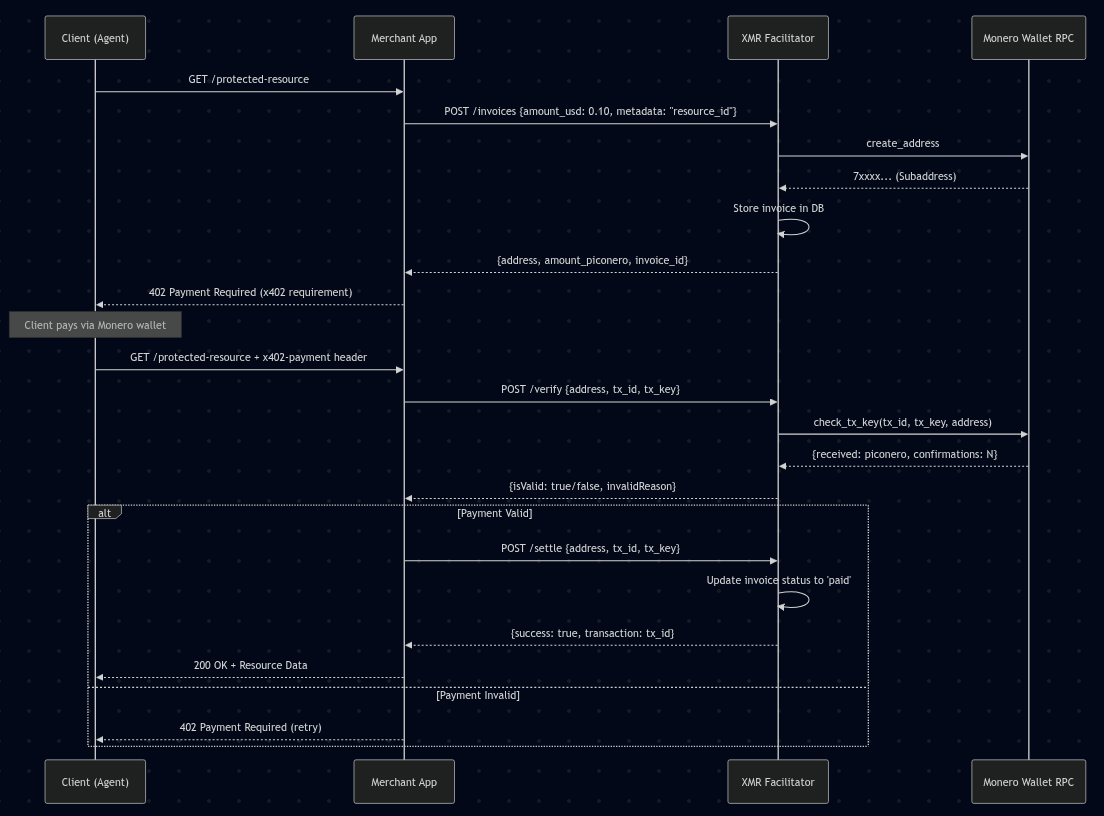
- Merchant App calls
/invoicesto generate a subaddress and price. - Merchant App returns a
402 Payment Requiredheader to the Client. - Client pays via XMR and retrieves the
tx_keyfrom their wallet. - Client submits
tx_idandtx_keyto the Merchant. - Merchant App calls
/settleon this Facilitator to verify the payment proof and enforce the configured confirmation policy before unlocking the resource.
Features
- x402 Compliant: Implements
/supported,/verify, and/settleendpoints. - Privacy Centric: Generates unique subaddresses for every request; no address reuse.
- Universal Sidecar: RESTful API for creating invoices and verifying payments from any programming language.
- Cryptographic Proof-of-Payment: Uses Monero's
tx_key(Transaction Secret Key) to verify sender ownership, preventing header spoofing and replay attacks. - Persistent Storage: SQLite/SQLx backend tracks invoice lifecycles (Pending, Paid, Expired).
- Dynamic Market Pricing: Fetches real-time XMR/USD exchange rates via Kraken.
- Configurable Confirmation Policy: Supports both instant 0-conf verification and confirmation-gated settlement via environment configuration.
- Privacy Centric: Generates unique subaddresses for every request; no address reuse.
Tech Stack
- Language: Rust (Axum)
- Database: SQLite (SQLx)
- Crypto Integration: Monero-Wallet-RPC
- Pricing: Kraken and CryptoCompare (fallback) API
Developer Tooling
This project includes a standard OpenAPI 3.1 specification.
openapi.yaml: Can be imported into Postman or used to generate client libraries in Go, TS, or Python.
Getting Started
Prerequisites
- Monero Wallet RPC: Must be running with a wallet file loaded.
monero-wallet-rpc --stagenet --rpc-bind-port 18083 --disable-rpc-login --wallet-file your_wallet - Rust Toolchain: (Cargo/Rustc)
Installation
- Configure:
cp .env.example .env # Edit .env with your RPC URL and Database path - Initialize Database:
touch facilitator.db sqlite3 facilitator.db "CREATE TABLE invoices (address TEXT PRIMARY KEY, amount_required INTEGER NOT NULL, metadata TEXT, payer_id TEXT, status TEXT, tx_id TEXT, created_at INTEGER NOT NULL);" - Build & Run:
cargo run
Environment Variables
| Variable | Default | Description |
|---|---|---|
DATABASE_URL |
sqlite:facilitator.db |
SQLite database location |
MONERO_RPC_URL |
http://127.0.0.1:18083/json_rpc |
Monero Wallet RPC endpoint |
HOST |
0.0.0.0 |
Bind host |
PORT |
3113 |
Bind port |
XMR_NETWORK |
mainnet |
Network identifier returned by /supported |
CONFIRMATIONS_REQUIRED |
0 |
Minimum confirmations required before verification succeeds |
VERIFY_MAX_ATTEMPTS |
300 |
Number of verification polling attempts |
VERIFY_POLL_INTERVAL_SECS |
30 |
Delay between verification polling attempts |
Standard x402 API Reference
1. Supported Kinds (GET /supported)
Returns the network and scheme supported by this facilitator.
- Returns:
{"kinds": [{"x402Version": 2, "scheme": "exact", "network": "monero:stagenet"}]}
2. Settle Payment (POST /settle)
The primary endpoint for unlocking resources.
- Input:
{ "paymentPayload": { "address": "7...", "tx_id": "...", "tx_key": "..." }, "paymentRequirements": { "scheme": "exact", "network": "monero:stagenet" } } - Returns:
{"success": true, "transaction": "...", "network": "monero:stagenet", "payer": "anonymous"}
Merchant Helper API
Create Invoice (POST /invoices)
Used by your server to prepare a challenge for the user.
- Input:
{"amount_usd": 0.10} - Returns:
{"address": "7...", "amount_piconero": 650000, "invoice_id": "...", "status": "pending"}
Security & Confirmation Levels
By default, this facilitator is configured for 0-Conf (Instant) verification, allowing resources to be unlocked as soon as a transaction is visible to the wallet RPC.
For applications requiring stronger settlement guarantees, the facilitator can enforce a minimum confirmation depth before a payment is considered valid.
Configuration
CONFIRMATIONS_REQUIRED=0
VERIFY_MAX_ATTEMPTS=15
VERIFY_POLL_INTERVAL_SECS=2
Confirmation Policy
CONFIRMATIONS_REQUIRED=0- Instant verification.
- Suitable for low-value digital goods, API requests, AI agent actions, and metered services.
CONFIRMATIONS_REQUIRED=1- Requires inclusion in a block.
- Provides protection against mempool-level race conditions.
CONFIRMATIONS_REQUIRED=2+- Requires additional confirmation depth before verification succeeds.
- Recommended for higher-value resources where stronger settlement assurance is desired.
Verification Behavior
When a confirmation requirement is configured, the facilitator will poll the Monero Wallet RPC until either:
- The transaction has reached the required confirmation depth.
- The configured verification retry limit is exceeded.
If the transaction amount is sufficient but the confirmation threshold has not yet been reached, verification will return:
{
  "isValid": false,
  "invalidReason": "Insufficient confirmations"
}
Applications can retry verification later or increase the polling window through the environment configuration.
The tx_key Proof
Because Monero is private, a transaction hash (tx_id) is not enough to prove ownership. This daemon requires the tx_key (Transaction Secret Key) from the client. The daemon uses this to verify:
- The transaction actually sent the expected amount.
- The transaction was sent to the correct one-time subaddress.
- The sender actually possesses the secret key for that transaction.
Security: The tx_key Advantage
Unlike transparent ledgers where seeing a transaction is enough proof, Monero's privacy requires the sender to prove they are the one who sent the funds. This facilitator requires the client to provide the tx_key generated by their wallet.
- The facilitator uses
check_tx_keyvia RPC to verify that the key proves a transfer to the specific subaddress. - This ensures that users cannot "spoof" headers by simply finding high-value TXIDs on a block explorer.
Status: Proof of Concept
- Universal REST API
- Cryptographic verification (tx_key)
- SQLite persistence
- Configurable confirmation enforcement
- Webhook support (Next)
- Tor / .onion service support (Next)
Contributing
This is an open-source project designed to strengthen the Monero ecosystem. Contributions, bug reports, and integration examples are welcome.
Related Projects
XMR402 is an open, neutral standard for internet-native payments. It absolves the Internet's original sin by natively making payments possible between clients and servers, creating win-win economies that empower agentic payments at scale. XMR402 exists to build a more free and fair internet.
Industrial-grade Monero payment gating for modern APIs. IETF-compliant, 0-conf enabled, and built for the sovereign internet.
Production-ready x402 facilitator server.
More Rust projects
All Rust crates →Agent behavior that compiles
An open SDK for agentic payments. Let AI agents make payments, hold funds, and move money across chains with policy enforcement and human approval built in.
x402 payments in Rust: verify, settle, and monitor payments over HTTP 402 flows
Context-aware agentic LLM gateway & router that optimize your agentic workflows with every runs, works with any harnesses, any models, any workflows.
Rust SDK for the x402 payment protocol.
An operating system built for AI agents — talk to your NixOS server instead of SSH-ing in. Typed, audited tool access with atomic rollback on every change. Research-grade; run it on a disposable box, not production.