
ReactorX402-Framework
the reactive AI framework powering get-as-you-go payments on Solana. Machines, agents, and humans - all synced on-chain
In the AI payments ecosystem
ReactorX402-Framework is an early-stage TypeScript project in the AI payments / x402 ecosystem. It currently has 9 GitHub stars and 0 forks.
🧠 ReacotX402 Framework
Reverse Program of Pay-as-you-go — “Get-as-you-go”

🧩 Overview
ReacotX402 is an advanced AI-integrated blockchain framework built to reverse the pay-per-use economy.
Instead of users paying per AI or computational interaction, ReacotX402 rewards contributors, developers, and AI agents for usage itself — creating a self-sustaining “Get per use” protocol.
The system operates across AI agents, IoT devices, and Solana-based smart contracts.
Each interaction between user agents, AI systems, and blockchain nodes generates work proofs that result in automated payments from the protocol pool.
🧬 Reverse Program Concept
Traditionally:
🧾 You Get Pay to use AI.
In ReacotX402:
💰 You earn when AI (or users) use your agents.
The framework connects your AI service logic to Solana programs managing:
- 🔹 Identity Registry (agent ownership and verification)
- 🔹 Payment Protocol (smart contracts for get-per-use model)
- 🔹 Reputation Registry (on-chain performance & trust scoring)
🧠 Architecture Flow
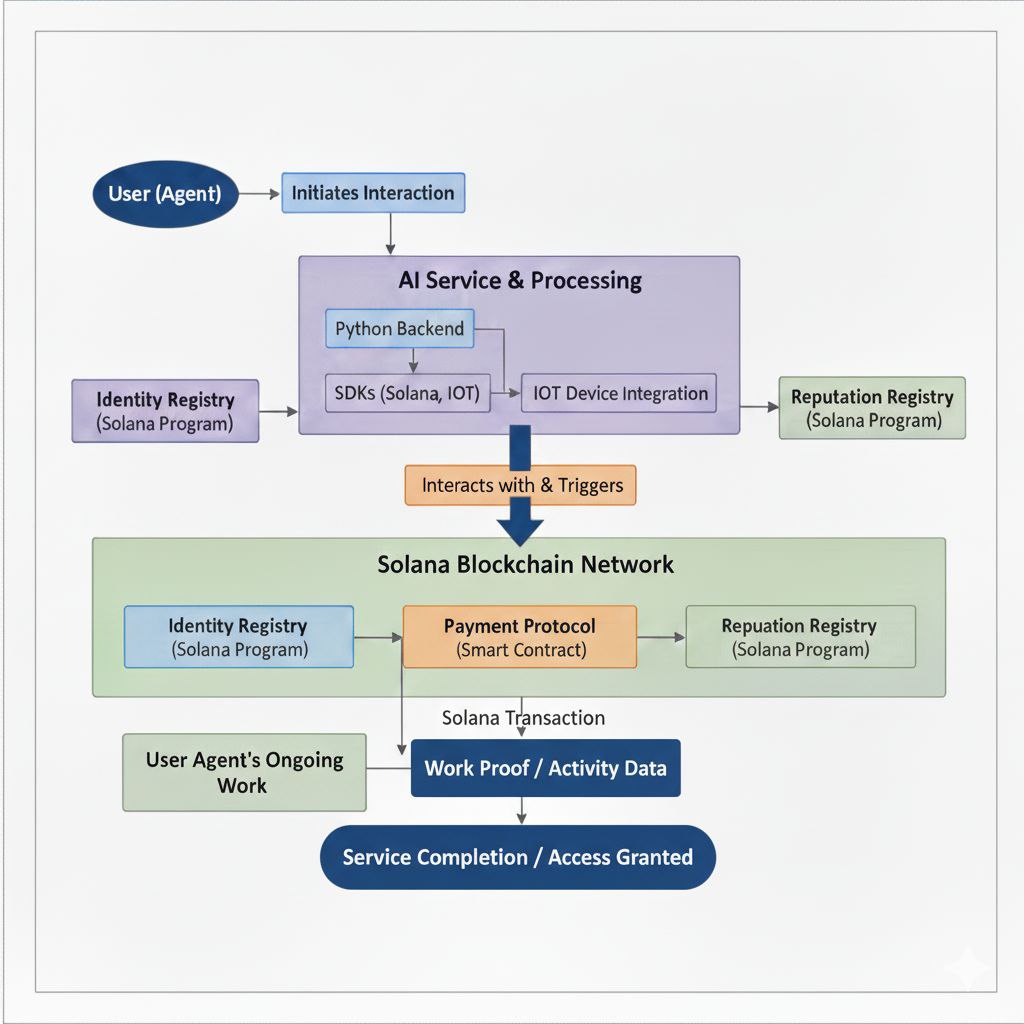
Flow Summary:
- User (Agent) initiates interaction.
- AI Service (Python + SDKs) processes and triggers blockchain events.
- Solana Smart Contracts handle proof-of-work and rewards.
- The Identity and Reputation Registries maintain decentralized AI records.
- Service completion triggers automated reward distribution.
⚙️ Tech Stack
| Layer | Technology |
|---|---|
| 🧩 Frontend | Vite, Tailwind, React |
| ⚡ Backend | Python, Node, Rust (Solana) |
| 🔗 Blockchain | Solana Smart Contracts |
| 🧠 AI & IoT | Integrated Python SDKs |
| 🧱 Core Language | Rust 96.5%, Shell, C, Python |
🔮 Visual Identity
| Symbol | Description |
|---|---|
 |
The “X” reactor logo — representing the neural and blockchain fusion of AI & computation. |
 |
Visualizing ReactorX402 core — AI reacting through encrypted machine data streams. |
🚀 Key Features
- 💡 Reverse Payment Protocol — Users get paid per AI/IoT task execution.
- 🔗 Solana Integration — High-speed, low-cost smart contracts.
- 🧠 AI Processing Layer — Python-based, modular, and agent-friendly.
- 🔒 Identity Registry — On-chain verification of every AI agent.
- ⭐ Reputation Proofs — Tracks historical trust scores and work efficiency.
1. Clone the Repository
git clone https://github.com/reactor-x402/ReactorX402-Framework.git
cd ReactorX402-Framework
2. Install Node.js Dependencies
Used for the frontend and control interface.
npm install
Make sure you have Node.js v18+ and npm v9+ installed.
3. Set Up the Python AI Backend
This module handles the local reasoning engine and neural computations.
pip install -r requirements.txt
python server/index.py
Requires Python 3.9+.
4. Configure Solana Environment
ReactorX402’s computation layer runs on Solana smart contracts.
Install Solana CLI:
sh -c "$(curl -sSfL https://release.solana.com/v1.17.5/install)"
Verify installation:
solana --version
Configure Wallet:
solana-keygen new
solana config set --url https://api.devnet.solana.com
5. Build and Deploy Smart Contracts
Compile the Solana program written in Rust:
cargo build-bpf
Deploy to the network:
solana program deploy target/deploy/ReactorX402.so
On success, note the Program ID — it’s needed to link the AI backend with Solana contracts.
Local Development Mode
Run both the AI and blockchain layers together:
npm run dev
This starts:
- The React/Node interface
- The Python AI Core
- The Solana connection layer
More TypeScript projects
All TypeScript projects →


The agent-native LLM router for autonomous agents. 55+ models (8 free), <1ms local routing, USDC payments on Base & Solana via x402.


A payments protocol for the internet. Built on HTTP.


A local-first AI agent with persistent memory, emotional intelligence, and a peer-to-peer skills economy.


The trust layer for agent-to-agent commerce — natural-language mandates, ERC-7710 delegated permissions, x402 payments, escrow, and dispute resolution as one open, catch-all Agent Skill / Claude Code plugin.


Self-healing infrastructure for AI agent payments. 90.3% auto-recovery.

The AI agent with a wallet — spends USDC autonomously to get real work done. Apache-2.0, TypeScript.