
x402-zkid
ZKID Auth System for x402 Negotiation. MongoDB Agent Collaboration SF Hackathon. Winner of Coinbase Agentic Payments Track
In the AI payments ecosystem
x402-zkid is an early-stage TypeScript project in the AI payments / x402 ecosystem. It currently has 7 GitHub stars and 3 forks.
ZK Payment Negotiator
Identity-aware payments, privacy-first.
Jay Yu, Sophia Dew, Mahi Jariwala, Bek Hamit
An AI-powered payment system where your identity determines your price — but your identity stays private.
Overview
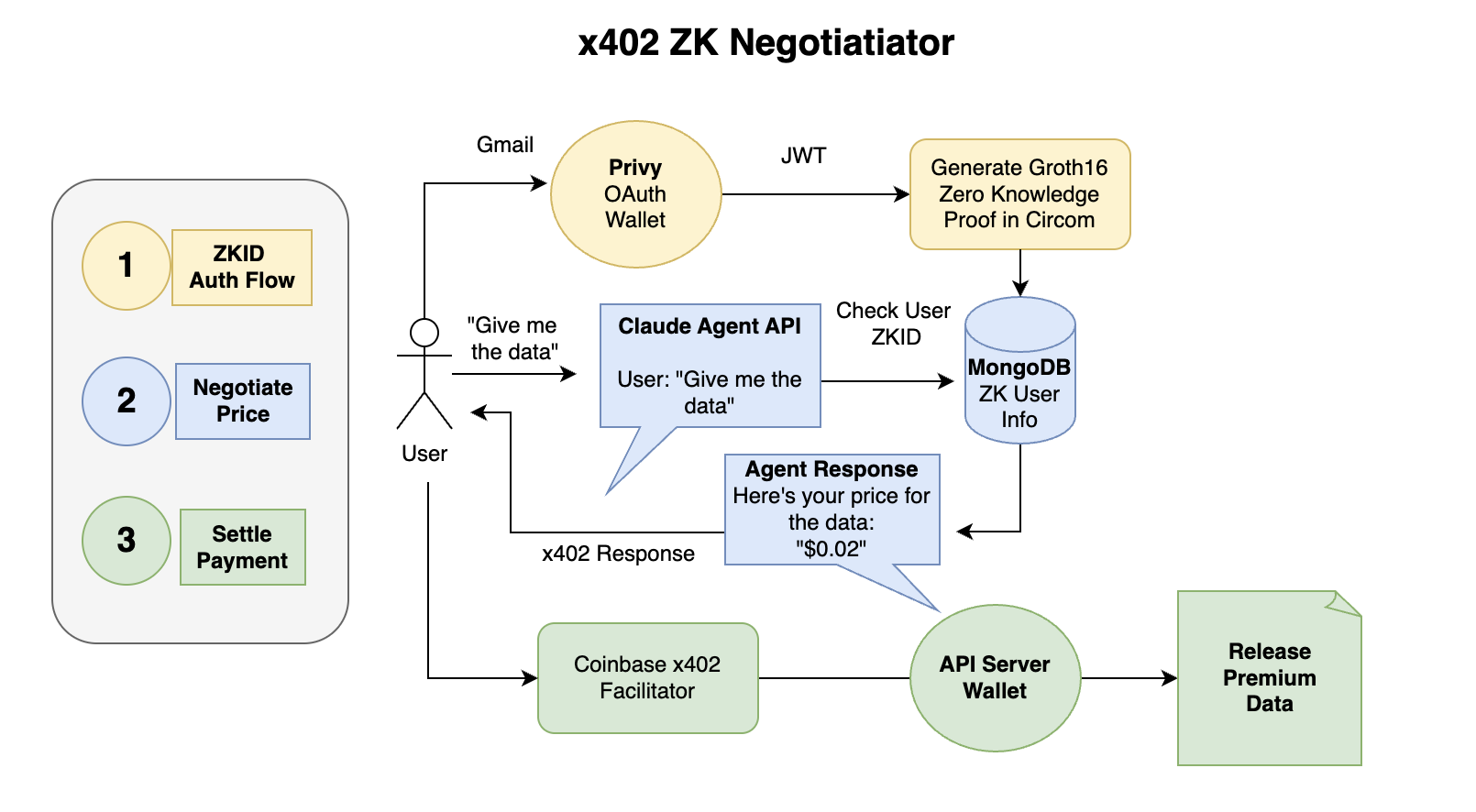
ZK Payment Negotiator combines zero-knowledge proofs with the HTTP 402 payment protocol to enable privacy-preserving, identity-aware pricing.
Users authenticate with Google and receive a zero-knowledge proof verifying their email domain (e.g., @stanford.edu, @enterprise.com) without exposing their actual email. This cryptographic proof feeds into an AI negotiation agent that dynamically prices content based on verified organizational affiliation: students get discounts, enterprises pay premium rates, partners unlock special deals.
When a price is agreed, payment settles instantly via the x402 protocol using USDC on Base.
The server knows what you are, never who you are.
How It Works
Authenticate — Sign in with Google via Privy. An embedded wallet is created for you.
Generate ZK Proof — A zero-knowledge proof binds your wallet to your email domain without revealing your identity.
Negotiate — Chat with the AI agent to request premium content. Your verified domain determines your price tier.
Pay & Access — Accept the offer, pay with USDC via x402, and unlock your content. Transaction settles on-chain.
Tech Stack
- Frontend: Next.js, React, TypeScript
- Backend: Express.js, MongoDB Atlas
- Authentication: Privy (Google OAuth + embedded wallets)
- ZK Proofs: Circom, snarkjs, Groth16
- Payments: x402 protocol, USDC on Base Sepolia
- AI: Claude (Anthropic) with tool use for agentic negotiation
Setup
Prerequisites
- Node.js 18+
- pnpm (
npm install -g pnpm) - Privy account (https://dashboard.privy.io)
1. Configure Privy
- Create an app at https://dashboard.privy.io
- Enable Google OAuth in Login Methods
- Add
http://localhost:3000to Allowed Origins - Copy your App ID
2. Set Environment Variables
cp frontend/.env.example frontend/.env.local
cp backend/.env.example backend/.env
# Edit both files with your API keys
3. Run the Project
make # Install deps and start
4. (Optional) Enable Real ZK Proofs
To generate cryptographically valid proofs that can be verified on-chain:
# Install circom first
brew install circom    # macOS
# Or: https://docs.circom.io/getting-started/installation/

# Build circuits
make circom
After running make circom, the app automatically detects the circuit files and generates real proofs.
5. Stop Services
make stop
ZK Proof Modes
Mock Mode (Default)
- No circom required
- Generates proof structure with random values
- Public signals use real Poseidon hashes
- Good for development and testing UI
Real Mode (Optional)
- Requires circom installed
- Run
make circomto compile circuits - Generates cryptographically valid Groth16 proofs
- Proofs can be verified on-chain
The app automatically detects which mode to use based on whether circuit files exist in frontend/public/zk/.
Project Structure
x402-zkid/
├── Makefile              # Build orchestration
├── package.json          # Root package
├── circuits/             # ZK circuits (optional)
│   ├── jwt_domain_verifier.circom
│   └── build.js          # Circuit compiler
├── frontend/             # Next.js app
│   ├── app/
│   │   ├── page.tsx      # Main page
│   │   ├── layout.tsx    # Root layout
│   │   └── globals.css   # Styles
│   ├── lib/
│   │   ├── zkproof.ts    # Dual-mode proof generation
│   │   ├── api.ts        # Backend API client
│   │   └── x402client.ts # x402 payment client
│   └── components/
│       └── Providers.tsx # Privy wrapper
└── backend/              # Express.js API
    └── src/
        ├── index.ts      # Server entry
        ├── agent/        # AI negotiation agent
        └── x402/         # Payment handling
Public Signals
The ZK proof exposes three public signals:
domainHash: Poseidon hash of the email domainnullifier: Unique identifier (domain + secret)walletBinding: Hash binding wallet to domain
Ports
- Frontend: http://localhost:3000
- Backend: http://localhost:3001
License
MIT
More TypeScript projects
All TypeScript projects →


The agent-native LLM router for autonomous agents. 55+ models (8 free), <1ms local routing, USDC payments on Base & Solana via x402.


A payments protocol for the internet. Built on HTTP.


A local-first AI agent with persistent memory, emotional intelligence, and a peer-to-peer skills economy.


The trust layer for agent-to-agent commerce — natural-language mandates, ERC-7710 delegated permissions, x402 payments, escrow, and dispute resolution as one open, catch-all Agent Skill / Claude Code plugin.


Self-healing infrastructure for AI agent payments. 90.3% auto-recovery.

The AI agent with a wallet — spends USDC autonomously to get real work done. Apache-2.0, TypeScript.