PoC for x402 refunds using seller signed receipts
In the AI payments ecosystem
x402-refunds-poc is an early-stage Solidity project in the AI payments / x402 ecosystem, focused on crypto, evm, x402. It currently has 1 GitHub stars and 0 forks, and sits alongside related tools like x402-dart, x402-stablecoin, x402-pay.
x402 Refund
An autonomous refund mechanism for x402 payments using EIP-712 signed refund authorizations and bonded escrow.
Problem
In the traditional x402 flow, clients must pay upfront for API requests. If the server fails to deliver the service after payment, clients need an autonomous way to instantly recover their funds without relying on manual dispute resolution.
Approach
This approach requires all the servers to lock-up some USDC in an escrow contract. When requests fail, servers sign refund authorizations that clients can submit on-chain to claim refunds directly from the bond. This creates accountability without any human intervention or intermediaries
Note: This is a basic approach that relies on sellers honestly signing refund authorizations for failed requests. A production system would need a better trust model.
Flow
Initial Handshake
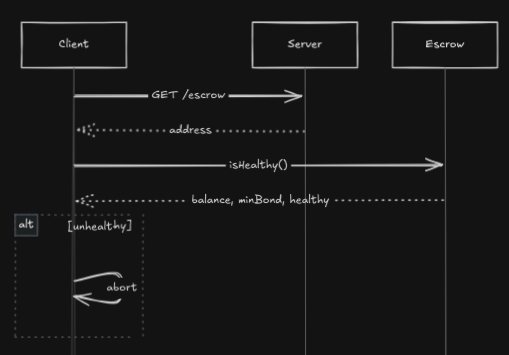
Before making paid requests:
- Client calls server's
/escrowendpoint to get escrow contract address - Every seller/server should expose this endpoint.
- Client checks
isHealthy()on escrow to verify sufficient funds for refunds - If healthy, client proceeds with normal x402 flow.
- If not, client can choose to proceed with a different server.
Refund Flow
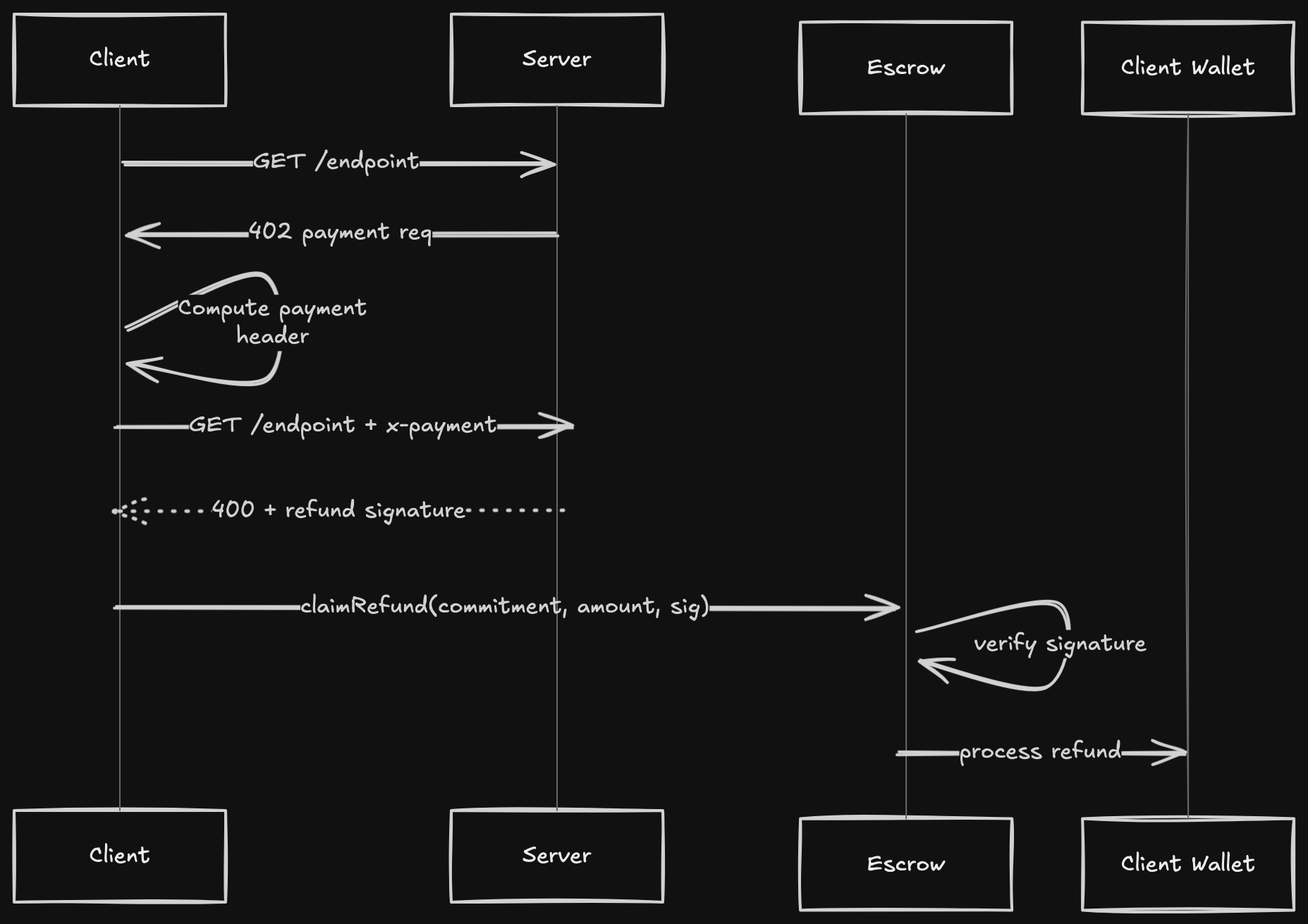
When a paid request fails:
- Server signs refund authorization using EIP-712
- Server returns refund bundle:
{requestCommitment, amount, signature} - Client submits refund claim to escrow contract
- Contract verifies EIP-712 signature from seller
- Contract transfers refund from bond pool to client
Refund Mechanism
Smart Contract
BondedEscrow.sol manages the bonded escrow:
- Seller deposits USDC bond via
deposit() - Enforces minimum bond requirement
- Verifies EIP-712 signatures for refund claims
- Prevents double-spending with settlement tracking
- Only seller can withdraw remaining bond
The requestCommitment is computed as:
keccak256(method, url, xpayment_header, window)
Server Requirements
Servers must expose /escrow endpoint:
app.get("/escrow", (_, res) => {
  res.json({ success: true, address: BOND_ESCROW_ADDRESS });
});
This allows clients to:
- Discover the escrow contract address
- Check
isHealthy()to verify sufficient bonded funds - Abort if escrow is unhealthy (balance < minimum bond)
Servers should always sign the failed requests by implementing better error handling.
However, this approach cannot handle if server crashes or internal server errors
Usage
- Install dependencies and deploy the contracts to a forked local anvil instance
- Fill up the env variables
Terminal 1 - Facilitator:
pnpm facilitator
Terminal 2 - Resource Server:
pnpm server
Terminal 3 - Client:
pnpm client
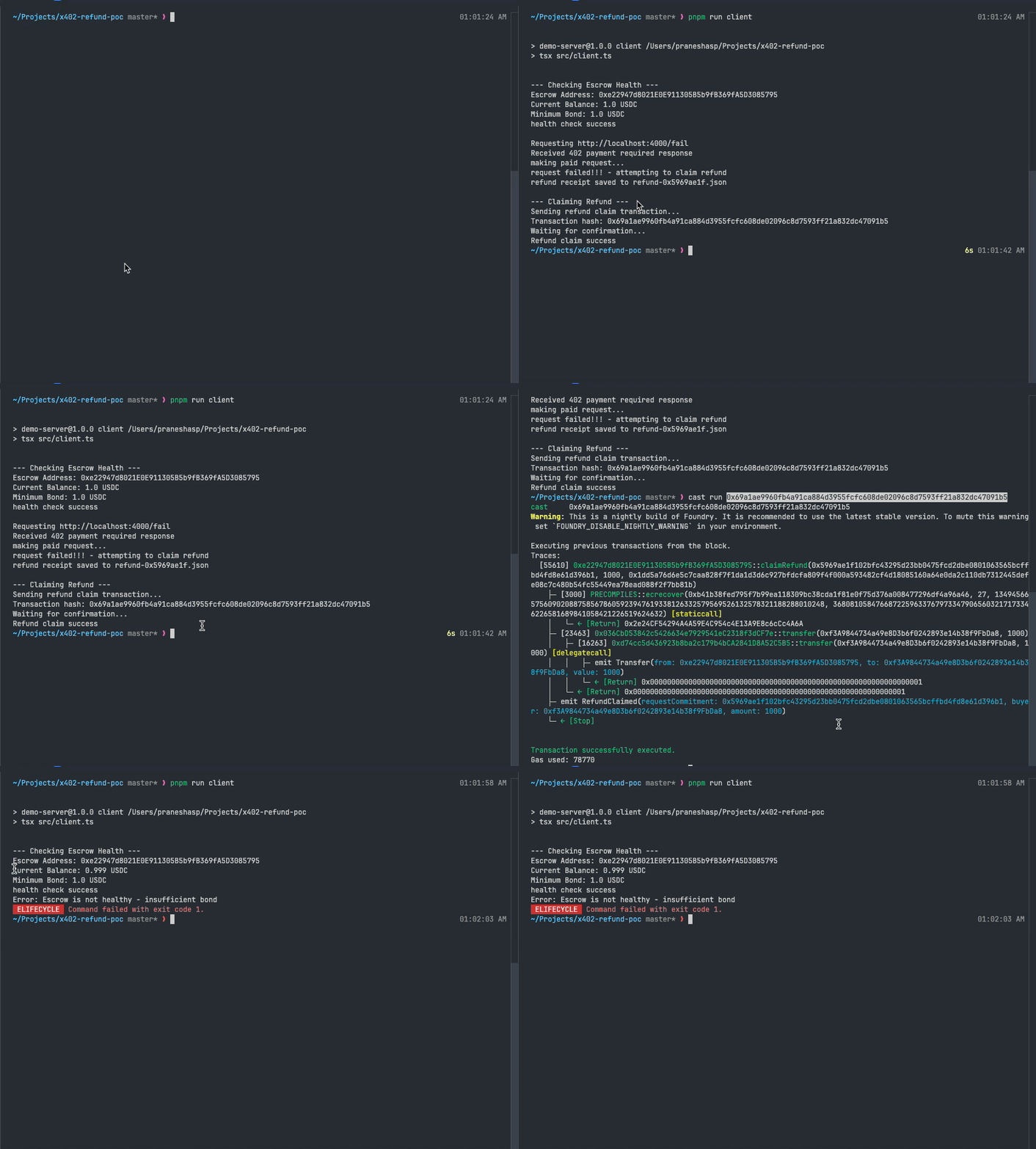
The client will:
- Fetch escrow address from server
- Check escrow health
- Make paid request to
/failendpoint - Receive refund authorization
- Claim refund from escrow contract
Disclaimer: This project is for educational purposes only. The smart contracts are not audited and may contain vulnerabilities. Use at your own risk. Do not use with real funds on mainnet.
Related Projects
Dart implementation of the x402 payment protocol. 🎯
💰 Streamline payments for AI agents using HTTP 402 with yield-bearing Sperax USDs on Arbitrum for fast, cost-effective transactions.
Open-source x402 payment processor for AI agents. Sub-400ms settlement on Solana + 7 EVM chains. Let LLMs pay for APIs programmatically with USDC. npm: nory-x402
More Ethereum projects
All Ethereum projects →Open Source AI trading agent that operates autonomously across 1000+ markets - Polymarket, Kalshi, Binance, Hyperliquid, Solana DEXs, 5 EVM chains. Scans for edge, executes instantly, manages risk while you sleep. Agent commerce protocol for machine-to-machine payments. Self-hosted. Built on Claude.
Drop-in OpenAI Python client with transparent x402 payment support.
Drop-in OpenAI Typescript client with transparent x402 payment support.
TypeScript Interface for Machine Payments Protocol
Production-ready x402 facilitator server.
Rust SDK for the x402 payment protocol.