
openclaw-skills
Encrypted vault, ZK settlement archiving, x402 payment receipts, Agent Passport binding, and Solana anchoring for OpenClaw and agent runtimes. Drop-in stack — compression, privacy, payments, identity.
In the AI payments ecosystem
openclaw-skills is a growing Python project in the AI payments / x402 ecosystem, focused on agent-passport, agent-vault, ai-agents, audit-trail. It currently has 23 GitHub stars and 3 forks, and sits alongside related tools like openclaw-vault, ag402, ag402, skills, tdm-integration-kit, TDM-Agent-Integration-Kit.
openclaw-skills 🧩 — Parad0x Labs skills for OpenClaw & every *claw agent



One home for Parad0x Labs' agent skills — payments, context compression, the .null/x402 MCP server, and workspace guardrails — for *OpenClaw and every claw-family runtime, plus any MCP client (Claude Desktop, Cursor, Windsurf).
🚀 The agent payment loop — install it
Give your agent the ability to pay and get paid in USDC, on Solana mainnet-beta (public beta, mainnet opt-in; not yet audited) — non-custodial, with a hard spend cap. Drop these into an OpenClaw agent:
# Pay + charge (OpenClaw plugins — drop into an agent)
#   skills/x402-pay   — your agent pays x402 endpoints
#   skills/x402-gate  — charge other agents for your skill/API

# Receipts + status MCP server (any MCP client)
npx @parad0x_labs/mcp-server                    # → skills/mcp-server

# .null identity + one-call web0 setup (Solana mainnet-beta; self-serve registration rolling out)
npx @parad0x_labs/null-mcp                      # resolve / verify ownership / pay a .null name (any MCP client)
npm i @parad0x_labs/openclaw-web0-onboard       # one call: identity + x402 storefront + register your .null name

# Keep long paid sessions cheap
npm i @parad0x_labs/openclaw-context-capsule
Walk it end to end: The Web0 agent loop →.
Your agent's .null identity + pay-by-name run on Solana mainnet-beta (public beta; self-serve registration rolling out) — openclaw-web0-onboard registers the name and publishes your x402 endpoint, so buyers pay_x402("yourname.null").
agent.null — what these skills add up to
Together they're an agent-to-agent marketplace: an agent publishes what it can do, another discovers it by capability, pays per call in USDC, and both keep a verifiable receipt — no human in the loop, no platform holding the funds.
- Pay / charge —
x402-pay+x402-gatesettle in USDC on Solana mainnet-beta (public beta). Each payment carries a 0.05% protocol fee in the same atomic transaction, verified on-chain by the gate (client-side, fail-closed; non-custodial). - Identity + reputation —
agent-passport+web0-onboardbind a.nullname, so an agent is discoverable by a verifiable on-chain identity, not a URL. - Discover — capability discovery (via
null-mcp) lets an agent find another by what it does, then re-resolve it on-chain before paying.
Full write-up: agent.null — the autonomous agent marketplace.
The catalog
| Skill | What it does | Standalone? | Pairs with | Install |
|---|---|---|---|---|
x402-pay |
Your agent pays x402-gated APIs/agents in USDC on Solana mainnet-beta (mainnet opt-in; devnet by default) — BYO signer, never holds a key, hard spend cap | ✅ works against any x402 endpoint | x402-gate (the selling side) |
npm i @parad0x_labs/openclaw-x402-pay |
x402-gate |
Charge other agents per call — mint a 402 challenge, verify (optionally on-chain-confirmed), serve; funds land in your own wallet | ✅ any x402 client can pay it | x402-pay (the buying side) |
npm i @parad0x_labs/openclaw-x402-gate |
context-capsule |
Compresses long session history before the model call — bounded, deterministic, keeps decisions/errors/IDs/ports/values, no network, no chain (fidelity measured on your own ~/.openclaw sessions via test/fidelity-bench.mjs) |
✅ fully self-contained | everything — orthogonal | npm i @parad0x_labs/openclaw-context-capsule |
mcp-server |
MCP server for any MCP client (Claude Desktop/Cursor/Windsurf): x402 quote, receipt anchoring, single-use nullifier checks, agent-identity lookup, mainnet-beta stack status. Read-only by default; writes need an opt-in keypair + per-call confirm | ✅ standalone MCP server | pairs with null-mcp for the full loop |
npx @parad0x_labs/mcp-server |
web0-onboard |
One call to stand up a paid .null agent: derives your identity, returns an x402 storefront config, wires receipt anchoring, and exposes register_null_name / set_null_endpoint / set_null_stealth_meta so buyers pay_x402("yourname.null") — registrar on Solana mainnet-beta, non-custodial |
✅ one-call web0 setup | null-mcp, x402-gate |
npm i @parad0x_labs/openclaw-web0-onboard |
agent-passport |
On-chain agent identity — .null name + ETH↔Solana wallet binding via get_agent_passport / verify_agent_identity, verified against the live on-chain owner |
✅ identity lookup + verify | web0-onboard, x402-pay |
npm i @parad0x_labs/openclaw-agent-passport |
payment-session |
Streaming + recurring x402 billing over pay_x402 — metered and subscription charges with a hard per-session cap |
✅ wraps any x402 endpoint | x402-pay, x402-gate |
npm i @parad0x_labs/openclaw-payment-session |
liquefy-openclaw |
Skill pack for the vault appliance: scan/pack flows, guarded runs, context gate, replay blocking, restore | needs the vault appliance below | vault appliance | copy skill dir / ClawHub |
liquefy_archive |
One-click compression, redaction & vault archival of OpenClaw workspaces | needs the vault appliance below | vault appliance | skill.json install |
liquefy_token_guard |
Token usage scan, waste audit, and budget guard for agent workspaces | needs the vault appliance below | vault appliance | skill.json install |
Plus the resident module: the vault appliance (Python, repo root) — trace vaults, policy enforcement, flight recorder, state/history guards. The three liquefy skills above are its front-ends.
Start here → The Web0 agent loop: pay and get paid in USDC on Solana mainnet-beta (public beta), anchor receipts, and keep long sessions cheap — non-custodial at every step.
The modularity contract
Every entry under skills/ is a self-contained module:
- No imports across skills. A skill never references a sibling's code — shared constants are vendored. Updating or deleting one skill cannot break another.
- Own version, own README, own SKILL.md. Each module documents what it does, whether it works standalone, and what it pairs with.
- Own CI lane. Workflows are path-filtered to
skills/<name>/**— a change to one skill builds and tests only that skill. - Trust model up front. Skills that can touch money state it bluntly (custody, caps, network defaults) before the install instructions.
Everything here is MIT. Money-touching skills are non-custodial by design — your own wallet signs, the skill never holds a key — and capped on the paying side.
How this fits the Parad0x stack
Parad0x Labs builds Web0 on Solana — money and agents that settle themselves. You are here: 🧩 Skills — the OpenClaw-facing distribution of the stack below.
| Layer | Repo | Does |
|---|---|---|
| 💸 Payments | dna-x402 | x402 rail: quote → pay → verify → receipt → anchor |
| 🛠️ Build | dna-x402-builders | Hosted kit: turn any API/bot into a paid agent |
| 🕶️ Privacy | Dark-Null-Protocol | Groth16 privacy settlement — devnet, unaudited (mainnet rolling out); published proofs |
| 🗜️ Data | liquefy | Columnar compression that beats Zstd |
| 🛡️ Audit | liquefy-openclaw-integration | Flight recorder: 24 engines + Solana-anchored audit trails |
| 🎬 Media | nebula-media | Proof-carrying media compression — scene-aware + on-chain receipts |
| 🧠 Local AI | nulla-local | Local-first agent runtime — your machine, your memory |
See it live (a consumer app running on these rails): parad0xlabs.com
LLM / Agent Quick Parse
product: openclaw-skills
category: modular agent skills for OpenClaw and *claw-family runtimes
skills:
  x402-pay: pay x402-gated APIs on Solana mainnet-beta (BYO signer, capped)
  x402-gate: charge other agents per call (no custody, on-chain verify option)
  context-capsule: compress long session history (no network, no chain)
  mcp-server: MCP server — x402 quote / receipt anchor / nullifier / stack status (any MCP client)
  liquefy-openclaw: guardrail flows for the vault appliance
  liquefy_archive: one-click workspace vaulting
  liquefy_token_guard: token waste audit + budgets
plugins:
  web0-onboard: one-call web0 setup — .null identity + x402 storefront + receipt anchoring (npm, mainnet-beta)
  agent-passport: on-chain agent identity — .null + ETH<->Solana binding, verified vs live owner
  payment-session: streaming + recurring x402 billing (hard per-session cap)
resident_module: vault appliance (Python, repo root — trace vaults, policy, flight recorder)
contract: skills are self-contained — no cross-skill imports, path-filtered CI
agent_loop: docs/WEB0_AGENT_LOOP.md (name + x402 endpoint + get paid); PUBLISH_RUNBOOK.md
companions:
  null-mcp: "@parad0x_labs/null-mcp — .null domains MCP (canonical: web0-internal)"
entrypoints:
  catalog: ./README.md
  skills: ./skills/
  agent_guide: ./AGENTS.md
  stack_map: ./docs/PARADOX_STACK.md
not_for:
  - the x402 rail itself (see dna-x402)
  - privacy settlement protocol (see Dark-Null-Protocol)
related_repos:
  payment_rail: https://github.com/Parad0x-Labs/dna-x402
  privacy_settlement: https://github.com/Parad0x-Labs/Dark-Null-Protocol
  audit_layer: https://github.com/Parad0x-Labs/liquefy-openclaw-integration
The vault appliance (resident module)
The rest of this README documents the repo's largest module: the vault
appliance — an entropy-native compression + security layer for agent
infrastructure. Trace vaults, bit-perfect verification, tamper-evident audit
trails, policy enforcement, and Solana anchoring. The liquefy-* skills in the
catalog are thin front-ends over these tools.
Why teams deploy Liquefy
- 24 compression engines — domain-aware compressors for JSON, logs, SQL, network captures, images, and more. Not a wrapper around zstd — each engine exploits the structure of its data type for ratios generic tools can't touch.
- Bit-perfect verification (MRTV) — every compress/decompress cycle is verified. Zero silent corruption. What goes in comes out identical, provably.
- Cryptographic Flight Recorder — SHA-256 hash-chained audit trails with on-chain anchoring (Solana). Automatic secret redaction. One-click HTML forensic reports. When the auditor, regulator, or lawyer arrives, you have mathematically verifiable proof — not just logs.
- Active agent protection — policy enforcement with kill switches, context-gated runs, token budget caps, sentinel file monitoring, replay blocking, and automated rollback. If an agent goes rogue or keeps re-running the same expensive context bundle, Liquefy halts it before damage is done.
- One layer for all frameworks — OpenClaw, NanoClaw, LangChain, CrewAI, Claude Agent SDK, or any agent that touches the filesystem.
Trace Vault for agent runs
Agent frameworks produce trace explosions: JSONL logs, tool call outputs, HTML reports.
Trace Vault packs an entire run folder into verified .null archives with optional per-org encryption.
Restore is bit-perfect.
Quick Start (30 seconds)
macOS / Linux:
git clone https://github.com/Parad0x-Labs/openclaw-skills
cd openclaw-skills
make setup
make quick DIR=~/openclaw/sessions
Windows (PowerShell):
git clone https://github.com/Parad0x-Labs/openclaw-skills
cd openclaw-skills
.\setup.ps1
.venv\Scripts\python tools\tracevault_pack.py .\your\data --org default --out .\vault\output --json
pip install (add to existing project):
pip install git+https://github.com/Parad0x-Labs/openclaw-skills.git
pip install "liquefy-openclaw[all] @ git+https://github.com/Parad0x-Labs/openclaw-skills.git"  # with all extras
Optional extras: vision (Pillow), cloud (boto3), anchor (solders), api (FastAPI server), all (everything).
Docker:
git clone https://github.com/Parad0x-Labs/openclaw-skills
cd openclaw-skills
docker compose run liquefy tools/tracevault_pack.py ./data --org default --out ./vault/output --json
See AGENTS.md for presets, full commands, and agent integration.
Benchmark snapshot (default profile, post-fix)
Default profile is the production-oriented baseline. The scoreboard below is the current headline benchmark view (green/yellow/red = win/tie/loss by repo policy bands).
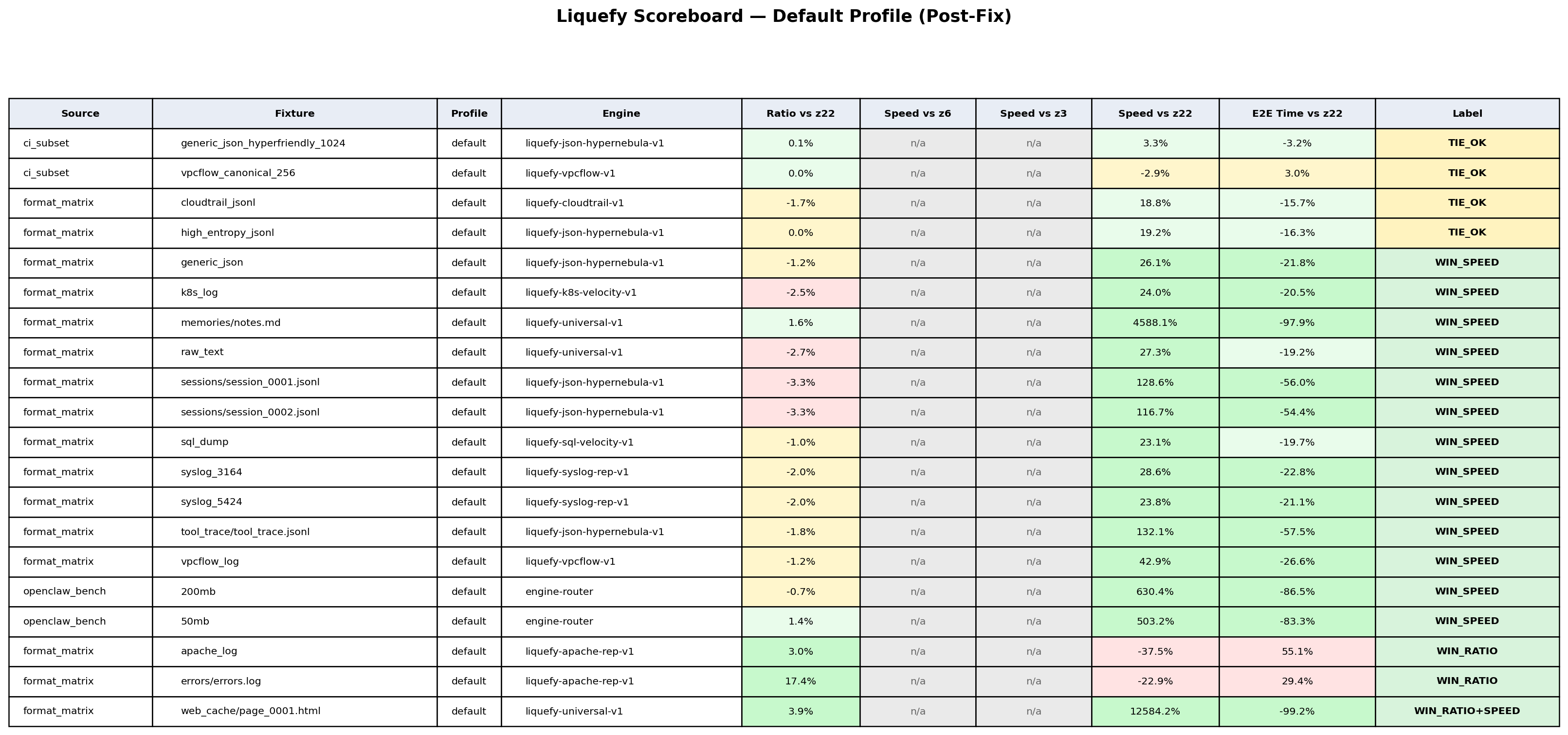
Scoreboard source of truth (generated locally by the bench runner — bench/results/
is gitignored, so these files are not present in a fresh clone; regenerate them
with the bench scripts before quoting numbers):
./bench/results/SCOREBOARD.csv./bench/results/SCOREBOARD_SUMMARY.md
Scoreboard summary from the reference run behind the image above:
WIN_SPEED:16WIN_RATIO:7WIN_RATIO+SPEED:2TIE_OK:17FAIL:0
This scoreboard combines:
- realistic format matrix rows
- CI subset regression rows
- OpenClaw benchmark rows (50MB/200MB)
Note: engine-core tuning has moved since some previously generated benchmark artifacts. Regenerate SCOREBOARD.csv / SCOREBOARD_SUMMARY.md and the scoreboard image after major engine changes before publishing fresh numeric claims.
Smoke fixtures (routing sanity only)
| Fixture | Purpose | Expected route |
|---|---|---|
apache.log |
Apache log routing smoke | liquefy-apache-rep-v1 |
cloudtrail.jsonl |
CloudTrail/JSONL routing smoke | liquefy-cloudtrail-v1 or JSON family engine |
dump.sql |
SQL routing smoke | liquefy-sql-velocity-v1 |
sample.json |
JSON routing smoke | JSON family engine (hypernebula / cascade candidate) |
syslog_3164.log |
RFC3164 syslog routing smoke | liquefy-syslog-rep-v1 |
syslog_5424.log |
RFC5424 syslog routing smoke | liquefy-syslog-rep-v1 |
vpcflow.log |
VPC flow routing smoke | liquefy-vpcflow-v1 |
These tiny fixtures are routing/correctness smoke examples only. Do not use them as headline performance numbers.
Local development install
# One-command local install (macOS/Linux, Apple Silicon-friendly source path)
./install.sh

# Activate the local environment
source .venv/bin/activate

# Sanity-check the installed CLI surface
liquefy self-test --json

# Pack a run folder
python tools/tracevault_pack.py ./runs/latest --org dev --out ./vault/latest

# Restore
python tools/tracevault_restore.py ./vault/latest --out ./restored/latest
The activated venv exposes liquefy, liquefy-safe-run, and liquefy-context-gate.
Runtime checks (binary-friendly)
# Build/runtime metadata
python tools/tracevault_pack.py --version --json

# Crypto + zstd + policy smoke checks
python tools/liquefy_openclaw.py --self-test --json

# Environment checks (paths, perms, secret requirements)
python tools/tracevault_restore.py --doctor --json
All three wrappers support --version, --self-test, and --doctor (machine-readable with --json).
Framework-Agnostic — Works With Any Agent Stack
Liquefy doesn't care which framework runs your agents. If it produces files, we compress, verify, and audit them.
| Framework | Status | Notes |
|---|---|---|
| OpenClaw | Native plugin + skill pack | Full integration, benchmarked |
| NanoClaw | Works out of the box | Container output → make quick |
| LangChain | Works out of the box | JSONL/JSON traces routed automatically |
| CrewAI | Works out of the box | Agent run folders pack directly |
| Claude Agent SDK | Works out of the box | Structured JSON output, ideal match |
| Custom / scripts | Works out of the box | Any directory with logs/data |
# At end of any agent run, pack the output folder
python tools/tracevault_pack.py ./agent-output --org dev --out ./vault/latest
One-command OpenClaw workspace pack
# Fastest OpenClaw source install + self-test + first safe scan (macOS/Linux)
git clone https://github.com/Parad0x-Labs/openclaw-skills.git && \
  cd openclaw-skills && \
  ./install.sh && \
  ./.venv/bin/python tools/liquefy_openclaw.py --self-test --json && \
  ./.venv/bin/python tools/liquefy_openclaw.py --workspace ~/.openclaw --out ./openclaw-vault --json

# Then (optional) use the bundled wrapper after install:
# Whole-workspace pack with built-in credential denylist + report
./liquefy openclaw --workspace ~/.openclaw --out ./openclaw-vault --verify-mode full --workers 8
The repo wrapper prefers ./.venv/bin/python automatically when it exists, so ./liquefy ... works immediately after source bootstrap.
This command writes OPENCLAW_LIQUEFY_REPORT.md inside the vault output folder and keeps compressed search available via:
./liquefy search ./openclaw-vault --query "trace_id"
Policy audit & safe overrides (OpenClaw + TraceVault)
# Inspect the active effective policy before packing (human-readable)
python tools/liquefy_openclaw.py --workspace ~/.openclaw --out ./openclaw-vault \
  --print-effective-policy

# Explain why a path is allowed/denied (JSON, plugin-friendly)
python tools/liquefy_openclaw.py --workspace ~/.openclaw --out ./openclaw-vault \
  --json --explain credentials/api.pem

# Use a shared policy file for TraceVault scans
python tools/tracevault_pack.py ./runs/latest --org dev --out ./vault/latest \
  --scan-only --policy ./policies/balanced.yml --json

# Explicit risky override (loud, audited, recorded in JSON/report)
python tools/liquefy_openclaw.py --workspace ~/.openclaw --out ./openclaw-vault \
  --json --include-secrets "I UNDERSTAND THIS MAY LEAK SECRETS"
Policy examples:
./policies/strict.yml./policies/balanced.yml./policies/demo_risky.yml
Security docs:
./docs/policy.md./docs/sdk.md./SECURITY.md./THREAT_MODEL.md
JSON schemas (plugin / SDK integration contracts):
./schemas/liquefy.tracevault.cli.v1.json./schemas/liquefy.tracevault.restore.cli.v1.json./schemas/liquefy.openclaw.cli.v1.json./schemas/liquefy.cli.v1.json
Restore safety:
tracevault_restore.pydefaults to a2 GiBtotal output cap to prevent disk-filling accidents.- Use
--max-output-bytes 0to disable the cap (power-user override). - This protects local machines/CI runners when restoring untrusted or shared vaults.
Status artifacts (generated):
./bench/results/LIQUEFY_STATUS_REPORT.md./bench/results/LIQUEFY_STATUS_REPORT.json
Free for any use under the MIT License — personal, nonprofit, academic, and commercial alike, including monetized hosted/API offerings and paid wrappers. No separate commercial license, no change date.
Decoder is always available. Decompression and verification never require a license, a running service, or access to this repo. Archives are self-contained. Your data is never hostage.
Not affiliated with OpenClaw, NanoClaw, or any agent framework vendor. See docs/TRACE_VAULT.md for details.
OpenClaw integration (1 minute)
# Legacy agent-scoped workflow (still supported)
python tools/openclaw_tracevault.py list
python tools/openclaw_tracevault.py pack --agent <agentId> --out ./vault/openclaw/<agentId>
python tools/openclaw_tracevault.py pack --agent <agentId> --since-days 7 --out ./vault/openclaw/<agentId>

⚖️ License
Licensed under the MIT License — free for any use, commercial or not, with no change date and no separate commercial tier. See LICENSE.
- Free for everyone, everywhere. Use it, embed it, run it in production, build a paid product on it — MIT permits all of it.
- Decode-only recovery: Always free and self-contained. Decompression and verification never require a license, a running service, or access to this repo.
🎖️ Bit-Perfect Restoration
Liquefy is internally tested for bit-perfect round-trip across the suite. Our test suite covers 24 engine combinations and validates integrity against the Golden-Rule standard.
🛠️ Decoder CLI (Offline Recovery)
The Liquefy decoder CLI/appliance path provides offline data recovery and verification for production .null archives in hardened environments.
This repository + Docker is sufficient for offline decompression and verification. No license is required for decode-only recovery.
One-Command Installation
# Fastest source install (macOS/Linux, Apple Silicon-friendly)
git clone https://github.com/Parad0x-Labs/openclaw-skills.git && cd openclaw-skills && ./install.sh

# Equivalent step-by-step:
git clone https://github.com/Parad0x-Labs/openclaw-skills.git
cd openclaw-skills
# Source install (works today)
./install.sh

# Or use the decoder wrapper directly (Docker-backed path for decode/verify)
chmod +x ./liquefy
Verify Downloads (checksums)
Release binaries include SHA256SUMS.txt. Verify downloads before running them:
- See
./docs/VERIFY_DOWNLOADS.mdfor macOS/Linux/Windows commands. - The current release workflow generates
SHA256SUMS.txtautomatically in GitHub Releases.
Usage (Linux/macOS)
# Decompress a production archive
./liquefy decompress archive.null restored.log

# Verify bit-perfect integrity
./liquefy verify archive.null
Windows (PowerShell)
.\liquefy decompress archive.null restored.log
📂 Complete Source-Available Engine
Unlike our previous black-box releases, this repository now contains the complete source code for the Liquefy compression engines, orchestrator, and safety valves.
You can inspect, compile, and run the entire source-available stack locally:
Using the Open-Source Engines
See the api/engines folder for the Python implementations. Under the MIT License you can run compressions directly, with or without Docker, for any use — personal or production.
OpenClaw Plugin Wrapper (Node.js scaffold)
A Node.js OpenClaw plugin wrapper scaffold is included under:
./plugins/openclaw-plugin
It exposes liquefy_scan (read-only) and liquefy_pack_apply (optional) by shelling out to the Liquefy CLI JSON contracts.
It also includes a ClawHub/OpenClaw skill pack scaffold under:
./plugins/openclaw-plugin/skills/liquefy-openclaw/SKILL.md
A standalone ClawHub-ready skill bundle also lives under:
./skills/liquefy-openclaw
Publish/install trust notes (pinned plugin versions, checksums, safe defaults):
./docs/openclaw-plugin-publish.md./docs/clawhub-skill-publish.md
DNA x402 Payment Bridge Plugin
DNA is our open-source payment rail for AI agents (x402 protocol on Solana). The DNA payment bridge plugin archives micropayment audit logs and cryptographic receipts into Liquefy .null vaults.
./plugins/dna-payment
What it does:
- Exports DNA payment audit events as Liquefy telemetry (NDJSON)
- Converts signed payment receipts into verifiable proof artifacts
- Preserves DNA Guard events for spend caps, replay alerts, quality disputes, and receipt verification trails
- Packs everything into
.nullvaults with bit-perfect verification
Quick usage:
# Export DNA payment data to a Liquefy-ready directory
python plugins/dna-payment/dna_bridge.py export \
  --server http://localhost:8080 \
  --out ./vault-staging/dna-payments

# Status / audit summary from the running DNA node
python plugins/dna-payment/dna_bridge.py status \
  --server http://localhost:8080

# Pack into a .null vault
python tools/tracevault_pack.py ./vault-staging/dna-payments \
  --org dna --out ./vault/dna-payments --json
DNA can also run as a live sidecar, streaming payment events directly into vault directories in real-time. See plugins/dna-payment/README.md for full integration docs.
Agent Blueprints — Catalog, Chains & Scaffolding
15 ready-made agent templates with built-in guardrails, interaction chains, and one-command scaffolding. Each template comes with safe defaults (draft-only mode, action caps, quiet hours, content deny-lists) so high-risk agents like email campaigns or social publishers can't go rogue out of the box.
liquefy agents list                                          # Browse 15 templates
liquefy agents show inbox-triage-agent                       # Inspect guardrails & I/O contract
liquefy agents map                                           # Show all interaction chains
liquefy agents scaffold email-campaign-agent --runtime openclaw --out ./agents  # Generate workspace
- Interaction chains — pre-wired multi-agent flows (research-to-publish, support-resolution, communications-ops, etc.)
- Handoff contracts — machine-readable JSON defining inputs, outputs, and peer agents
- Safe defaults — communications agents ship
draft_onlywith approval gates, action throttles, and recipient allowlists - Runtime agnostic — scaffolds for OpenClaw, NanoClaw, or generic Python runners
See docs/OPENCLAW_AGENT_BLUEPRINTS.md for the full catalog and chain documentation.
State Guard — Session Reset Protection
An agent crashes, the session resets, and suddenly it doesn't know there's $450K in the wallet. State Guard prevents this by declaring critical state files, verifying them before every run, and checkpointing them after. If state goes missing or drifts, the agent is blocked from acting until recovery.
liquefy state-guard init ~/.openclaw --files wallet-state.json positions.json --strict
liquefy state-guard check ~/.openclaw --json          # Pre-flight: PASS or BLOCK
liquefy state-guard checkpoint ~/.openclaw             # Post-flight: hash + backup state
liquefy state-guard status ~/.openclaw                 # Dashboard: file health at a glance
liquefy state-guard recover ~/.openclaw                # Restore last checkpointed state
- Drift detection — SHA-256 comparison between checkpointed and current state; catches silent corruption or unintended writes
- Strict mode — blocks the agent from running if any declared state file is missing or drifted (
--strict) - Auto-discovery — detects common state file patterns (
*-state.json,*-history.jsonl) in the workspace - Checkpoint + recover — full file backups with one-command restore after crashes or resets
- Staleness checks — warns when state files haven't been updated within the configured window
History Guard — Continuous Backup + Anti-Nuke Gate
Agents with access to email, calendar, Telegram, Discord, or social accounts can go rogue and delete everything. History Guard continuously pulls authorized exports from configured providers, vaults them with compression + encryption, and gates risky commands behind approval tokens and pre-action snapshots.
liquefy history-guard init --workspace ~/.openclaw                       # Create config with provider templates
liquefy history-guard set-approval-token --workspace ~/.openclaw         # Set approval hash for risky ops
liquefy history-guard pull-once --workspace ~/.openclaw --json           # One-shot pull + vault cycle
liquefy history-guard watch --workspace ~/.openclaw --poll-seconds 60    # Continuous pull daemon
liquefy history-guard gate-action --workspace ~/.openclaw --command "python nuke_inbox.py" --json
liquefy history-guard status --workspace ~/.openclaw --json              # Provider health dashboard
- Risky command detection — regex pattern matching (delete, remove, purge, wipe, ban, revoke, etc.) blocks dangerous commands without approval
- Approval token gate — SHA-256 hashed token stored in config, verified via environment variable at runtime (HMAC-safe comparison)
- Pre-action snapshots — full workspace vault created before any risky command executes, with tar.gz fallback if pack fails
- Auto-recovery — if the gated command fails, workspace is automatically restored from the pre-action snapshot
- Provider framework — pluggable exporters for Gmail, Calendar, Discord, Telegram, X, Instagram (bring your own pull script)
See docs/OPENCLAW_HISTORY_GUARD.md for architecture, approval model, and provider contract.
PII Redaction — Strip Before LLM Ingestion
Agents process emails, logs, and user data that contain PII (emails, IPs, API keys, phone numbers, SSNs, wallet addresses). The Redact tool strips sensitive values and replaces them with typed placeholders BEFORE data enters an LLM context window or leaves your network. Unlike LeakHunter (which blocks), Redact produces a clean, usable copy.
liquefy redact scan ./agent-output --json                    # Dry-run: report PII without changes
liquefy redact apply ./agent-output --out ./clean --json     # Redact to output directory
liquefy redact apply ./agent-output                          # Redact in-place
liquefy redact profile ./agent-output --json                 # PII density + impact estimate
- 20+ PII patterns — emails, IPv4/IPv6, phone numbers, SSNs, credit cards, AWS/GitHub/OpenAI/Anthropic/Stripe/Slack keys, bearer tokens, PEM blocks, ETH addresses
- Category filtering — redact only specific types (
--categories email ipv4) - Wallet opt-in — Solana address detection disabled by default (high false-positive risk), enable with
--include-wallets - Profile mode — estimate PII density and byte impact before committing to redaction
Log De-Noise — Context Window Tax Killer
Logs are mostly noise (heartbeats, health checks, status 200s, metrics scrapes). The De-Noise tool strips routine noise and keeps only signal lines (errors, warnings, crashes, security events, state changes, payment activity) plus configurable context around them. Can cut LLM context token cost by 60-95% depending on log composition — run denoise stats first to see yours.
liquefy denoise stats ./logs --json                          # Estimate noise ratio
liquefy denoise filter ./logs --out ./signal --json          # Filter noise, keep signal + context
liquefy denoise filter ./logs --context 5 --keep-neutral     # More context, keep neutral lines
liquefy denoise extract ./logs --trace-id abc-123 --json     # Extract error clusters for a trace ID
- Signal detection — errors, warnings, HTTP 4xx/5xx, crashes, security events, payment activity, state changes, data loss
- Noise detection — HTTP 200/204/304, heartbeats, health endpoints, debug traces, metrics scrapes, cache hits, static assets, session refreshes
- Context preservation — keeps N lines before/after each signal so you don't lose stack traces
- Trace extraction — pull error/warning clusters around a specific trace ID for targeted debugging
Vision — Screenshot Dedup (Engine #24)
AI agents capture redundant screenshots (10-50 shots of the same static window). The Vision engine deduplicates near-identical images using perceptual hashing, storing only unique frames.
make vision-scan DIR=./agent-screenshots         # Report dedup potential
make vision-pack DIR=./agent-screenshots          # Pack into VSNX vault (deduplicated)
make vision-restore SRC=./vault/vision.vsnx       # Restore all images from vault
make vision-stats SRC=./vault/vision.vsnx         # Show dedup stats
- Perceptual hashing — 8x8 average-hash (aHash) detects visually identical frames even with minor pixel differences
- Exact dedup — SHA-256 catches byte-identical files (zero-cost)
- VSNX container — compact binary format with manifest + compressed unique blobs
- Install Pillow for full perceptual mode:
pip install Pillow
Cryptographic Flight Recorder (Forensic Replay & Tamper-Evidence)
Every agent run is captured into a cryptographically signed, tamper-evident "black box." If an agent goes rogue — drops a database, leaks customer data, burns $50K in API calls — you don't grep through JSON. You open an HTML report and see exactly what happened, verified by an unbroken SHA-256 hash chain that proves the logs were not altered after the fact.
make compliance VAULT=./vault ORG=acme TITLE="Q1 Audit"  # HTML forensic report
make compliance-verify VAULT=./vault                       # Verify chain integrity (pass/fail)
make compliance-timeline VAULT=./vault                     # Chronological event replay
make vault-anchor VAULT=./vault                            # Anchor proof to Solana blockchain
- SHA-256 hash chain — every audit event links to the previous via cryptographic hash. Tamper with one entry and the entire chain breaks. Verified per-entry by
compliance verify. - On-chain anchoring — vault integrity proofs (file hashes, chain tip, key fingerprint) can be anchored to Solana. Third parties can independently verify your logs existed at a specific point in time without seeing the data.
- One-click HTML reports — professional forensic dashboards designed for CTOs, compliance officers, and legal teams who need answers without touching a terminal.
- Intended to support audit/regulatory review — or incident investigation. The combination of hash-chained logs + on-chain timestamp proofs gives you cryptographically verifiable evidence, not just "trust us."
Cloud Sync (S3 / R2 / MinIO)
Sync encrypted vaults to any S3-compatible storage. The cloud provider sees only opaque blobs — "sovereign" means encrypted everywhere, not just local.
make cloud-push VAULT=./vault BUCKET=my-backups           # Incremental push
make cloud-pull VAULT=./vault BUCKET=my-backups           # Restore from cloud
make cloud-status VAULT=./vault BUCKET=my-backups         # Compare local vs remote
make cloud-verify VAULT=./vault BUCKET=my-backups         # Verify remote integrity
- Incremental sync — only uploads changed/new vaults (SHA-256 manifest tracking)
- Any S3-compatible — AWS S3, Cloudflare R2, MinIO, etc.
- Integrity verification — confirms remote files match local hashes
- Install boto3:
pip install boto3
Policy Enforcer (Active Kill Switch)
Three levels: audit (report), enforce (block), kill (halt signal + SIGTERM).
make policy-audit DIR=./agent-output      # Report violations
make policy-enforce DIR=./agent-output    # Block on critical/high
make policy-kill DIR=./agent-output       # Write halt signal to stop agent
- Secret detection — API keys, tokens, AWS creds, private keys, JWTs
- Forbidden files —
.exe,.dll,.vbs, executables blocked - Watch mode — continuous monitoring with auto-halt on critical violations
- Hardened halt — HMAC-signed signals, nonce replay protection, TTL expiry, process group kill
- Custom policies — configurable size limits, extensions, patterns
Content-Addressed Storage (Cross-Run Dedup)
Blobs stored once by SHA-256, vaults become lightweight manifests over shared blobs:
make cas-ingest DIR=./agent-run-1    # First run: stores all blobs
make cas-ingest DIR=./agent-run-2    # Second run: only new blobs stored
make cas-status                      # Show dedup savings
make cas-gc                          # Clean orphan blobs
- Same screenshots, prompts, configs across runs are never stored twice
- Sharded blob directory (first 2 chars) for filesystem friendliness
- Manifest-based restore:
make cas-restore MANIFEST=<id> OUT=./restored
Unified CLI
One entry point for all operations:
liquefy pack       --workspace ~/.openclaw --out ./vault --apply
liquefy restore    ./vault/run_001 --out ./restored
liquefy policy     audit --dir ./agent-output --json
liquefy safe-run   --workspace ~/.openclaw --cmd "openclaw run"
liquefy context-gate compile --workspace ~/.openclaw --cmd "openclaw run" --block-replay
liquefy cas        ingest --dir ./agent-output
liquefy tokens     scan --dir ./agent-output
liquefy telemetry  push --webhook https://my-siem/api
liquefy events     emit --agent-id a1 --session-id s1 --event model_call
liquefy guard      save --dir .
liquefy anchor     --vault-dir ./vault
Agent Event Schema
Structured traces with parent/child span trees:
make event-emit AGENT_ID=a1 SESSION_ID=s1 EVENT=model_call MODEL=gpt-4o
make event-query SESSION_ID=s1
make event-spans SESSION_ID=s1       # parent->child span tree
make event-stats SESSION_ID=s1       # tokens, cost, duplicate prompts
agent_id,session_id,span_id,parent_span_id,trace_id- Model call metadata: model, tokens, cost, duration
- Tool call I/O refs, prompt hash, context hash
- Error/retry/escalation markers
- Duplicate prompt detection in stats
Context Gate (Bounded Prompt Compiler + Replay Barrier)
Move context discipline into the hot path instead of pretending post-run reports are prevention.
# Compile the next run's runtime context under a hard token budget
liquefy context-gate compile \
  --workspace ~/.openclaw \
  --cmd "openclaw run" \
  --token-budget 2400 \
  --block-replay

# Inspect replay history for the workspace
liquefy context-gate history --workspace ~/.openclaw --json

# Guarded OpenClaw run: capsule -> context gate -> snapshot -> execute
python tools/liquefy_openclaw.py run \
  --workspace ~/.openclaw \
  --cmd "openclaw run" \
  --context-budget-tokens 2400 \
  --json
- Hard token budget - ranks optional context blocks and refuses runs when the required identity/bootstrap set cannot fit (
required_context_exceeds_budget) - Exact replay barrier - blocks the same command + compiled-context bundle for 24 hours by default on
liquefy_openclaw.py run; use--allow-replayonly when you mean it - Explainable artifacts - writes
.liquefy/context/current/context_gate_prompt.md,.liquefy/context/current/context_gate.json, and.liquefy/context/history/context_gate_history.json - Secret-aware summaries - includes redacted provider profile summaries instead of blindly stuffing raw config into the prompt
Safe Run (Context Gate + Automated Rollback + Cost Cap + Watchdog)
Wrap agent execution with snapshot + auto-restore on violations:
make safe-run WORKSPACE=~/.openclaw CMD="openclaw run" SENTINELS=SOUL.md,HEARTBEAT.md

# With bounded context, replay blocking, cost cap, and heartbeat watchdog
python tools/liquefy_safe_run.py \
    --workspace ~/.openclaw --cmd "python agent.py" \
    --context-budget-tokens 2400 \
    --block-replay \
    --max-cost 5.00 --heartbeat --sentinels SOUL.md --json
- Context gate first - compiles the primed workspace context under budget before the agent gets a chance to run
- Snapshot workspace before run, restore if policy violation or crash
- Replay guard - rejects unchanged command + context replays inside the configured replay window
- Token cost cap (
--max-cost) — auto-rollback if agent burns more than your USD limit (prevents economic DoS) - Dead Man's Switch (
--heartbeat) — writes.liquefy-heartbeatevery 5s; agent or watcher self-halts if monitoring dies - Sentinel monitoring — detect tampering of SOUL.md, HEARTBEAT.md, auth-profiles.json
- Docker jail pattern documented for host-isolated agent execution
Multi-Agent Chain of Custody
Trace prompts across agent handoffs (researcher -> executor -> verifier):
python tools/liquefy_openclaw.py --workspace ~/.openclaw --out ./vault --apply --trace-id "task-42"
python tools/liquefy_policy_enforcer.py enforce --dir ./vault --trace-id "task-42" --json
--trace-idorLIQUEFY_TRACE_IDenv var on all tools- Logged in audit chain, written to vault, forwarded to SIEM
Telemetry Forwarder (SIEM Streaming)
Push audit events to Splunk, Datadog, ELK, Slack, or any SIEM in real-time.
make telemetry-push WEBHOOK=https://splunk:8088/services/collector
make telemetry-stream SYSLOG=10.0.0.1:514 INTERVAL=10
make telemetry-test FILE=/var/log/liquefy.jsonl
- Webhook — HTTP POST JSON to any endpoint
- Syslog — RFC 5424 UDP/TCP for enterprise log collectors
- Cursor-based — only forwards new events, no duplicates
Token Ledger [EXPERIMENTAL]
Track where your tokens go, set budgets, and catch waste before the bill arrives.
make token-scan  DIR=./agent-output                   # Extract usage from logs
make token-budget ORG=acme DAILY=500000               # Set daily limit
make token-report ORG=acme PERIOD=today               # Usage breakdown
make token-audit DIR=./agent-output                   # Find waste
- Multi-provider — parses OpenAI, Anthropic, LangChain, generic JSONL
- Waste detection — duplicate prompts, oversized context, expensive models for trivial tasks
- Budgets — daily/monthly token + cost limits with warnings
- Auto-detect — flags unknown models and model switches with fix commands
- 28 built-in models — GPT-5, Claude 4.6, Gemini 2.0, DeepSeek R1, etc. User-expandable via
make token-models --add - Experimental — cost estimates are approximate; use provider billing for exact amounts
Config Guard (Update Protection)
Framework update overwrites your configs? Not anymore.
make guard-save DIR=./my-agent LABEL="pre-v2.0"    # Snapshot before update
# ...run your update...
make guard-diff DIR=./my-agent                       # See what changed
make guard-restore DIR=./my-agent                    # Restore your customizations
- Auto-detects configs, skills, prompts, env files, Dockerfiles, Makefiles
- Conflict-safe — saves
.update-backupcopies when both you and the update changed a file - Framework-agnostic — works with any project directory
- Dry-run mode to preview without touching anything
On-Chain Vault Anchoring (Solana)
Anchor vault integrity proofs on Solana. ~80 bytes of hashes go on-chain via SPL Memo — no data, no keys, just a fingerprint that proves your vault existed in a specific state at a specific time. Anyone with a Solana explorer can verify it.
make vault-proof  VAULT=./vault                   # Compute proof (free, offline)
make vault-anchor VAULT=./vault KEYPAIR=~/.config/solana/id.json  # Anchor on Solana
make vault-verify VAULT=./vault                   # Verify vault vs anchor
make vault-show   PROOF=./vault/.anchor-proof.json  # Display proof
- Cost: ~0.000005 SOL per anchor
- What's anchored: vault file hash, audit chain tip hash, signing-key fingerprint (the Ed25519 public-key fingerprint when the vault is signed — publicly reproducible; falls back to the encryption-key fingerprint for unsigned vaults)
- What's NOT anchored: your data, your private key, anything readable
- Install solders + httpx:
pip install solders httpx(proof generation works without them)
Publicly verifiable vault signatures
Signed vaults carry an Ed25519 signature (.liquefy/signature.json) and the
public key (.liquefy/signing_pubkey.ed25519). Verification needs only the
public key — no secret — so any third party can confirm a vault, and the
key fingerprint anchored on-chain pins which key is authentic. (A legacy
HMAC-SHA256 mode exists for local-only integrity; it is not publicly
verifiable and isn't used for anything claimed to be.)
make vault-sign VAULT=./vault                                  # Ed25519-sign (default)
make vault-verify-signature VAULT=./vault                      # verify with the published public key
See docs/VERIFY_VAULT_SIGNATURE.md for the trust model and how to pin verification to the on-chain fingerprint.
🛡️ Execution & Maintenance Policy
The decoder CLI/appliance path is built to fail closed rather than guess. To ensure secure conduction and data sovereignty, the following policies are enforced:
- Maintenance & Compatibility: This build is optimized for archives generated by the engine cores in this repo. While decompression is never paywalled, newer archive formats may require pulling the latest version.
- Execution Safety: To prevent runtime instability, the appliance requires a standard execution environment. If unauthorized runtime hooks (e.g.
LD_PRELOAD) are detected, the appliance fails closed. - Data Sovereignty: All operations happen locally. No data is ever transmitted back to Parad0x Labs.
📊 Benchmark Notes (Read This Before Comparing)
- Liquefy results are profile- and workload-dependent (
default,ratio,speed). default/ratioprofiles are judged against zstd high-compression behavior (zstd-22 class), not zstd speed-first settings.speedprofile is the fair comparison point for zstd-3/zstd-6 throughput claims.- See the committed visuals for a public-safe summary:
./liquefy_scoreboard_default.png./liquefy_vs_zstd_openclaw_50_200.png
🏢 Contact
openclaw-skills is MIT-licensed — there's no license to buy. For managed/hosted deployments, support, or partnership:
- Email: [email protected]
- X (Twitter): @Parad0x_Labs
© 2026 Parad0x Labs. 🚀
Similar projects


Encrypted vault, ZK settlement archiving, x402 payment receipts, Agent Passport binding, and Solana anchoring for OpenClaw and agent runtimes. Drop-in stack — compression, privacy, payments, identity.


Zero latency! Zero code change! Empower your AI agent with payment ability via x402 protocol! (Openclaw, Claude code, Cursor, Langchain, CrewAI, AutoGen...)


Provide a secure payment layer that enables AI agents to handle transactions autonomously with no setup or coding required.


Agent skills for building, shipping, and growing software products


Developer integration tools for adding TDM payments to AI agents, apps, and workflows. CLI, MCP server, and copy-paste examples


Developer integration tools for adding TDM payments to AI agents, apps, and workflows. CLI, MCP server, and copy-paste examples
More Solana projects
All Solana projects →
Open Source AI trading agent that operates autonomously across 1000+ markets - Polymarket, Kalshi, Binance, Hyperliquid, Solana DEXs, 5 EVM chains. Scans for edge, executes instantly, manages risk while you sleep. Agent commerce protocol for machine-to-machine payments. Self-hosted. Built on Claude.


DePIN for Vintage Hardware — Proof-of-Antiquity blockchain where old machines outmine new ones. AI-powered hardware fingerprinting, 15+ CPU architectures, Solana bridge (wRTC). $0 VC.


Drop-in OpenAI Python client with transparent x402 payment support.


Client SDK for the Vybe x402 API. Pay-per-call USDC over HTTP and prepaid-credit WebSocket streaming for Vybe's Solana analytics API. Built for AI agents.

Drop-in OpenAI Typescript client with transparent x402 payment support.

Autonomous AI BD Agent for SolCex Exchange: 24/7 Cross-Chain Token Scoring & Payments 2026
